How to Manage Turf Heat: A Technical Guide to Thermal Mitigation
The proliferation of synthetic turf in the American residential landscape has historically been driven by the pursuit of water conservation and aesthetic consistency. However, as global thermal norms shift and urban heat island effects intensify, the primary challenge of synthetic surfacing has transitioned from maintenance to thermodynamics. Unlike natural grass, which utilizes transpiration, a biological evaporative cooling process to regulate its temperature, synthetic turf acts as a thermal battery. It absorbs electromagnetic radiation from the sun and converts it into sensible heat, often reaching surface temperatures that exceed 150°F on peak summer days.
This thermal gain is not merely a matter of physical discomfort; it is a complex engineering problem that affects the structural integrity of the polymers, the health of the local microclimate, and the safety of the end-users. Addressing this heat requires a fundamental understanding of how materials interact with the solar spectrum. To effectively intervene, one must move beyond simple surface cooling and look at the “Systemic Albedo” of the landscape, the ratio of reflected to absorbed solar radiation. Without a strategic approach to thermal management, the synthetic lawn risks becoming a radiant liability rather than an outdoor asset.
Managing this environment requires a departure from traditional “gardening” toward a discipline rooted in material science and environmental physics. It involves the integration of infrared-reflective (IR) pigments, specialized infill media that mimic the evaporative cooling of soil, and architectural shade interventions. This analysis provides a definitive reference for those seeking to master the physics of elevated turf temperatures. It is an exploration of how to reconcile the utility of synthetic surfaces with the thermodynamic demands of a warming world.
Understanding “How to Manage Turf Heat”

The primary hurdle in learning how to manage turf heat is the pervasive misunderstanding of “Heat Storage” versus “Heat Radiation.” Many property owners focus exclusively on the temperature of the fibers, neglecting the fact that the infill and the base aggregate act as a deep thermal reservoir. Even if the surface is temporarily cooled with water, the heat stored in the sand or crumb rubber below will rapidly conduct back to the surface once the water evaporates. A professional-grade strategy must address the entire “Thermal Stack,” from the tips of the polyethylene blades down to the stone base.
Oversimplification in this sector often leads to the “Irrigation Fallacy,” the belief that a quick spray from a hose is a permanent solution. While water is an excellent heat sink, synthetic turf lacks the “Stomata” found in natural grass that allow for controlled, long-term transpiration. Consequently, the cooling effect of water on standard turf is short-lived, often lasting less than 20 minutes under direct sunlight. A rigorous management plan incorporates “Evaporative Infill” technology, which utilizes porous materials like zeolites or treated sand to trap moisture and release it slowly over several days, mimicking the biological cooling of a living lawn.
Furthermore, we must account for the “Albedo Effect.” Darker colors naturally absorb more of the solar spectrum, including the invisible near-infrared (NIR) wavelengths that account for roughly 50% of the sun’s heating energy. Sophisticated management involves the selection of turf fibers that are engineered with “Cool-Fiber” technology polymers infused with NIR-reflective pigments that allow the fibers to reflect heat while appearing green to the human eye. Understanding this distinction between visual color and thermal reflection is the cornerstone of modern turf engineering.
Deep Contextual Background: The Evolution of Thermal Science
The history of synthetic turf is a trajectory from “Industrial Green” to “Thermodynamic Engineering.” In the early decades of the technology, the primary goal was durability. High-density polyethylene (HDPE) was used for its resilience, with little regard for its thermal properties. These “First Generation” systems often utilized crumb rubber infill recycled tires, which, due to their black color and high carbon content, acted as a perfect blackbody radiator, pushing surface temperatures to dangerous levels.
By the early 2010s, the “Second Generation” of thermal management emerged with the introduction of lighter-colored infills and more porous backings. However, it was the “Third Generation”, the current standard, that revolutionized the field by addressing the molecular structure of the fibers themselves. Today, we utilize “S-Shape” and “W-Shape” fibers not just for pile memory, but because their increased surface area allows for faster convective cooling. We are now entering an era where turf is viewed as a “Climate-Adaptive Surface,” integrated into the broader architectural strategy of the building to reduce cooling loads and improve outdoor habitability.
Conceptual Frameworks and Mental Models
To manage turf heat effectively, one should apply the following professional frameworks:
-
The Thermal Battery Model: View the turf and its infill as a battery that charges during the day and discharges at night. Management is the process of reducing the “Charge Rate” (absorption) and accelerating the “Discharge Rate” (convection/evaporation).
-
The Albedo/NIR Framework: Distinguish between what is visible and what is thermal. High-authority design prioritizes materials that are “NIR-Transparent” or “NIR-Reflective,” regardless of their green shade.
-
The Evaporative Cycle Model: Consider the infill not as a stabilizer, but as a “Sweat Gland.” The goal is to maximize the “Latent Heat of Vaporization,” the energy used to turn liquid water into gas, which is pulled directly from the turf fibers.
Key Categories: Material Resilience and Infill Variations
Mitigation strategies are categorized by their position in the “Thermal Stack.”
| Category | Component | Primary Mechanism | Thermal Reduction | Trade-off |
| Cool-Fiber Tech | Polymer Blades | NIR-Reflection | 10°F – 15°F | Higher material cost |
| Evaporative Infill | Zeolites/Porous Media | Latent Heat Release | 20°F – 30°F | Requires periodic hydration |
| Reflective Infill | Acrylic-Coated Sand | Albedo Increase | 5°F – 10°F | Can be visually “bright.” |
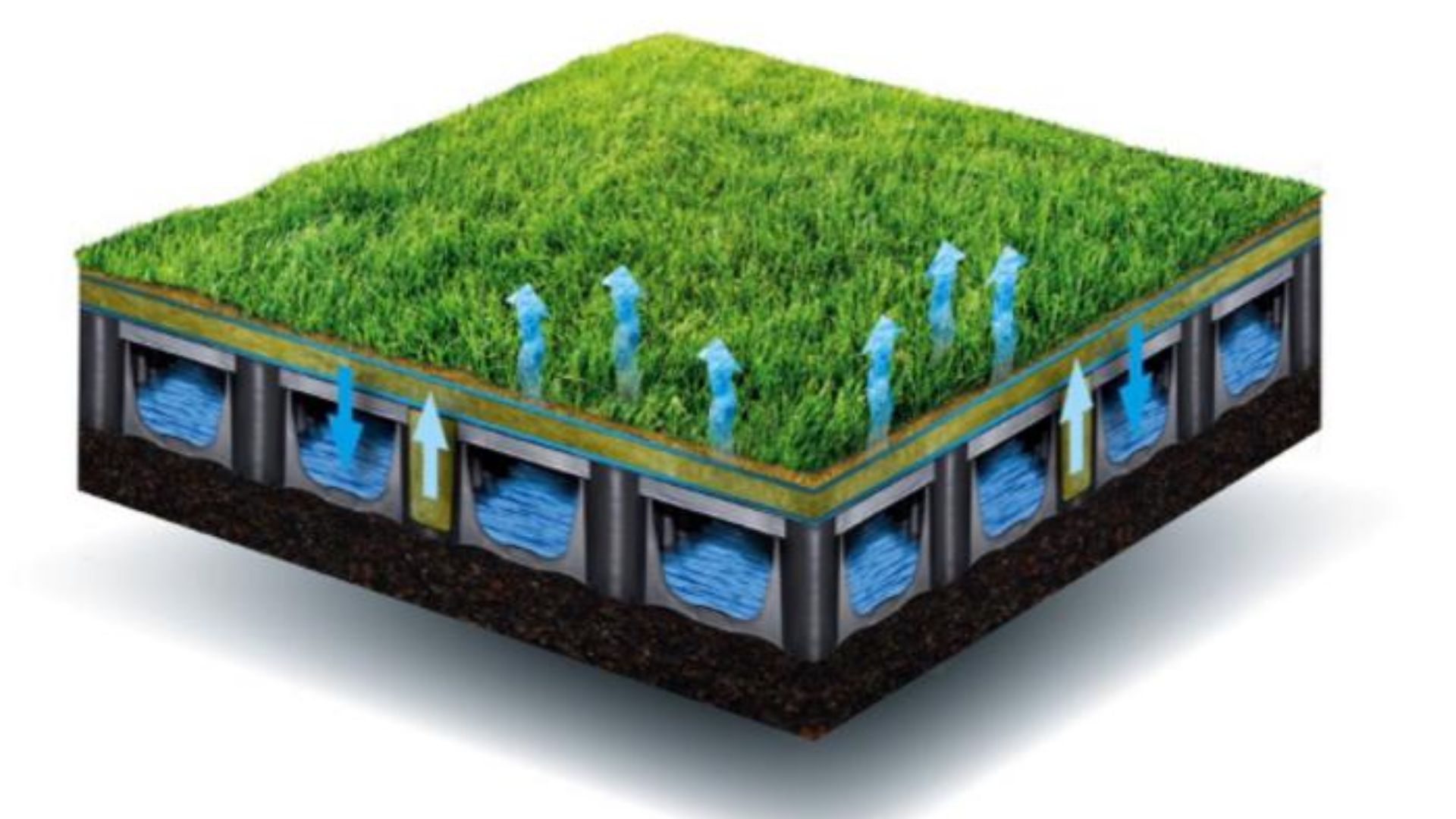
| Vented Base | Geocomposite Tiles | Convective Airflow | 3°F – 8°F | Complex installation |
| Architectural Shade | Canopies/Trees | Radiation Shielding | 40°F – 60°F | Permanent footprint |
| Hydro-Cooling | Retractable Sprinklers | Sensible Heat Sink | Variable (Short-term) | Water consumption |
Decision Logic for Implementation
In the American Southwest, where the UV index is consistently high, Cool-Fiber Tech paired with Evaporative Infill is the non-negotiable standard. In more temperate, humid climates, the focus shifts toward Vented Base systems to prevent moisture entrapment while providing moderate thermal relief.
Detailed Real-World Scenarios
Scenario A: The High-Desert Residential Backyard
Constraints: 105°F ambient temp, 12 hours of direct sun, zero shade trees.
The Strategy: Utilize an IR-reflective “S-shaped” fiber in a dual-tone olive shade. Use a 100% zeolite infill hydrated via a dedicated, automated “Misting Zone” that triggers for 5 minutes at 11:00 AM and 2:00 PM.
Result: Surface temperatures are maintained at a manageable 110°F-120°F, compared to 160°F+ for standard crumb rubber systems.
Scenario B: The Modern Glass-Walled Courtyard
Constraints: “Low-E” glass windows reflecting sunlight onto a concentrated turf area.
The Strategy: This scenario presents a “Magnifying Glass Effect.” The turf must be a high-melting-point nylon or a specialized “Heat-Resistant” polyethylene. The primary management tool here is architectural: installing a pergola or vertical privacy screens to break the line of reflection.
Failure Mode: Using standard turf in a reflection zone will lead to “Fiber Fusing” (melting) within the first season.
Planning, Cost, and Resource Dynamics
The economic profile of thermal management is an “Operational vs. Capital” trade-off.
| Investment Tier | Est. Cost (per Sq. Ft.) | Longevity Impact |
| Standard (No mitigation) | $3.00 – $5.00 | Higher UV rot; 10-year life |
| Mid-Tier (IR Fibers) | $5.00 – $8.00 | Reduced warping; 15-year life |
| Elite (Evaporative + IR) | $8.00 – $12.00 | Maximum stability; 20-year life |
| Architectural Integration | $15.00+ | Permanent comfort; high ROI |
Opportunity Cost: Failing to invest in cooling technology often leads to the “Abandoned Landscape” syndrome, where the yard becomes unusable for 4–5 months of the year, effectively wasting the initial capital investment.
Tools, Strategies, and Support Systems
-
Laser Thermometers: The primary diagnostic tool for identifying “Hot Zones” and verifying the efficacy of cooling interventions.
-
Automated Hydration Systems: Smart timers connected to subsurface soaker hoses or perimeter misters to keep evaporative infills charged.
-
High-Albedo Hardscaping: Surrounding the turf with light-colored pavers (like travertine) to reduce the “Ambient Glow” of heat from the surrounding environment.
-
Deciduous Strategy: Planting trees that provide canopy shade in the summer but allow the turf to receive UV (for sanitization) in the winter.
-
Subsurface Air-Void Tiles: Plastic grids that create an air gap beneath the turf, allowing heat to dissipate through the base rather than trapping it.
-
Enzymatic Bio-Cleaners: Necessary when using porous cooling infills to prevent the buildup of bacteria in the moisture-retention pores.
Risk Landscape and Failure Modes
-
Polymer Fusing: When surface temperatures exceed the “Glass Transition Temperature” (Tg) of the polyethylene, the fibers lose their structural memory and mat down permanently.
-
Thermal Expansion “Rippling”: Synthetic turf expands in heat. If the perimeter is anchored too tightly without accounting for “Linear Expansion,” the turf will develop waves or humps.
-
The “Steam Effect”: Hydrating a standard sand-filled green at high noon can create a localized humidity spike (steam) that is uncomfortable for users and can accelerate the breakdown of the turf backing.
Governance, Maintenance, and Long-Term Adaptation
Effective management is a “Seasonal Governance” task.
-
Pre-Summer Audit: Check infill levels. If the infill has migrated, the backing is exposed to direct UV and heat, leading to premature brittleness.
-
Hydration Cycles: In peak summer, the “Evaporative Battery” must be recharged. Weekly deep-soaks are more effective than daily light mists.
-
Shade Review: Pruning surrounding trees to ensure the turf gets “Dappled Light” enough for visual appeal, but not enough for maximum thermal load.
The Thermal Checklist
-
[ ] NIR-Reflectivity check: Are fibers showing signs of “sheen” degradation?
-
[ ] Infill porosity check: Is the zeolite still absorbing water, or is it clogged with silt?
-
[ ] Expansion gap check: Are the seams under tension due to thermal swelling?
-
[ ] Reflection audit: Are new Low-E windows or glass railings creating “Hot Spots”?
Measurement, Tracking, and Evaluation
-
The “Barefoot Test” Index: A qualitative but vital metric. If a person cannot comfortably stand on the turf for 60 seconds at noon, the mitigation strategy has failed.
-
Surface-to-Ambient Delta: The goal of high-authority management is to keep the turf temperature within 20°F of the ambient air temperature.
-
Evaporative Decay Rate: Tracking how long the turf stays cool after hydration. High-performance systems should maintain a lower temperature for at least 4–6 hours.
Common Misconceptions
-
Myth: “Darker green turf is always hotter.”
-
Correction: A dark green turf with IR-reflective pigments will be cooler than a light green turf without them. It is about pigment chemistry, not just color.
-
-
Myth: “Crumb rubber is the only infill that provides cushion.”
-
Correction: Specialized “Cool-Infill” (like coated sand) paired with a high-quality shock pad provides superior safety without the heat retention.
-
-
Myth: “Watering the turf uses more water than a real lawn.”
-
Correction: Hydrating a synthetic lawn for cooling uses roughly 10-15% of the water required to keep natural grass alive in the same climate.
-
-
Myth: “Turf heat is only a problem in the desert.”
-
Correction: In humid climates, the “Heat Index” on a synthetic lawn can be more oppressive due to reduced natural convection.
-
Ethical and Practical Considerations
The management of turf heat is also an ethical consideration regarding the “Urban Microclimate.” A large synthetic installation without cooling technology can raise the temperature of the neighboring properties and increase the cooling load of the home itself. Strategic design must include “Peripheral Cooling,” integrating living plants and high-albedo materials to offset the synthetic footprint. Furthermore, the selection of cooling infills should prioritize non-toxic, mineral-based materials (like zeolites) over chemical-heavy treatments to protect local groundwater.
Synthesis and Strategic Judgment
Mastering how to manage turf heat is the difference between a landscape that is a sanctuary and one that is a scorched barrier. It is a multi-layered discipline that begins at the molecular level with polymer selection and ends with architectural shade and hydrological management. By viewing the lawn as a thermodynamic system rather than a static carpet, the property owner can ensure the long-term resilience of the materials and the comfort of the environment.
The best strategy is a “Defense-in-Depth” approach: reflect the heat at the fiber, absorb it in the infill, and dissipate it through the base and surroundings.